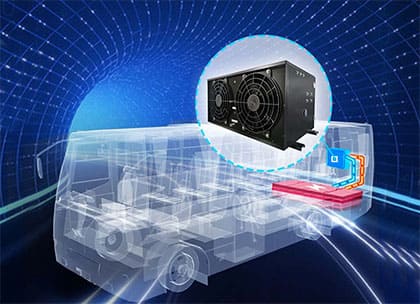
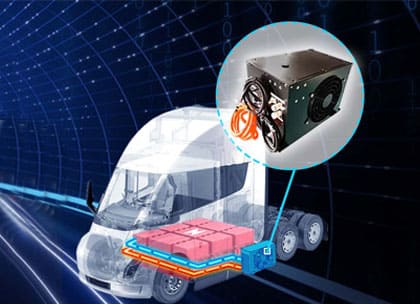
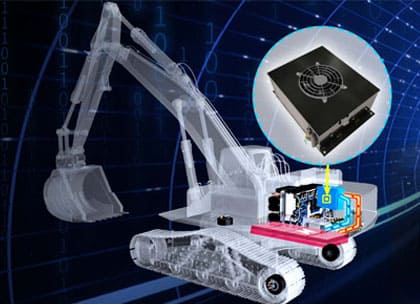
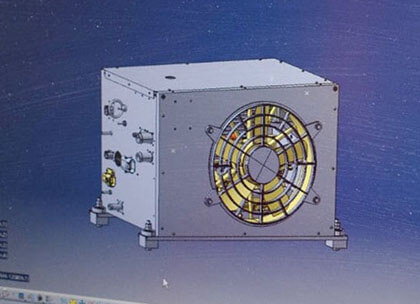
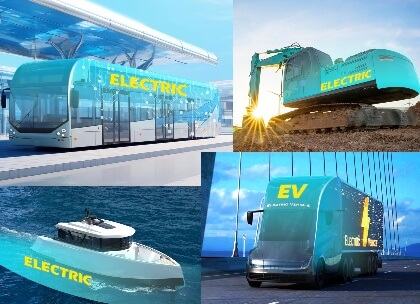
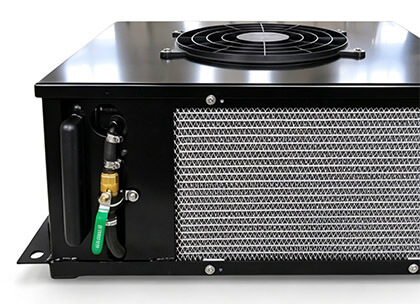
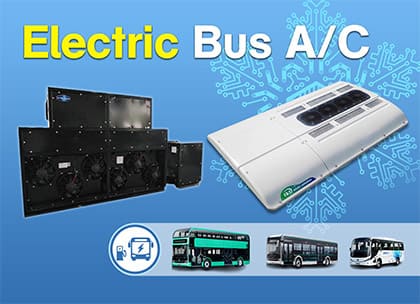
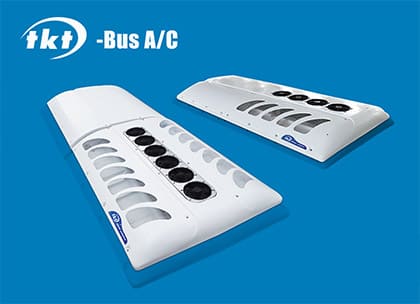
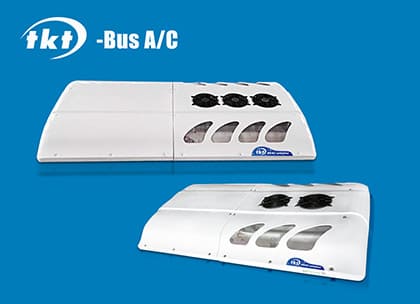
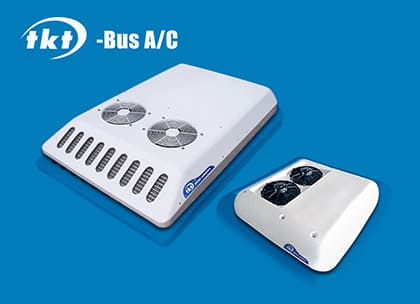
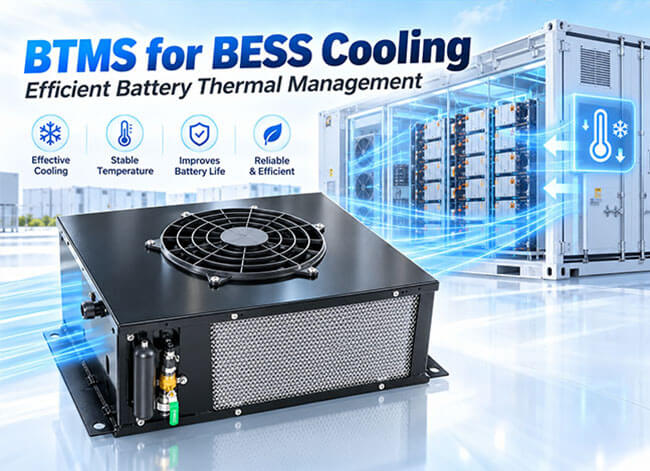
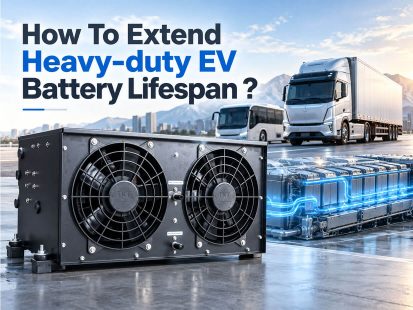
TKT standard product line of compact energy storage systems cooling solutions offers cooling capacities ranging from 3 KW a 10 kW. It is ideally suited as a BESS cooling system for mobile and compact energy storage systems. For more than a decade, TKT has been dedicated to designing and manufacturing liquid-cooled battery thermal management systems for electric buses, camion, and off-highway equipment, supplying these systems to Fortune 500 OEMs, including BYD and TATA Motors.
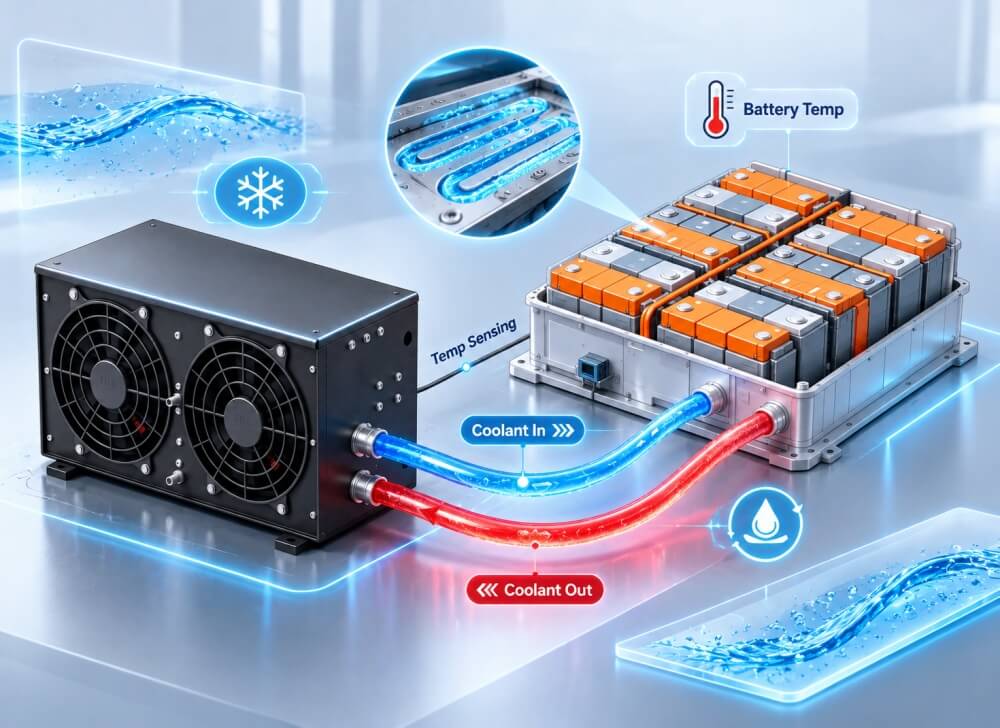
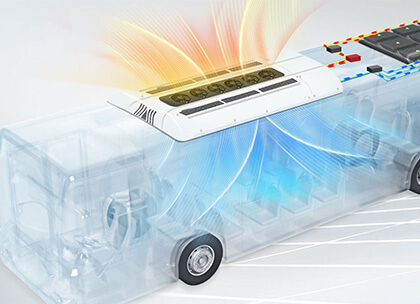
A simplified schematic diagram of the battery chiller principle
Scelto dai leader del settore
Gli OEM globali e gli operatori di flotte si affidano a TKT
“Il BTMS di TKT è stato determinante nel raggiungimento dei nostri obiettivi di elettrificazione della flotta. L’affidabilità del sistema e il supporto tecnico di TKT hanno superato le nostre aspettative.”
— OEM leader di autobus in India – MOTORI TATA
TKT contro. BTMS convenzionale
Vedi la differenza che conta
| Caratteristica |
TKTBTMS |
Convenzionale |
| Precisione della temperatura |
±0,5°C |
±2~3°C |
| COP riscaldamento |
Fino a 3.2 |
~1.0 (PTC) |
| Protezione |
IP67 |
IP54 tipico |
| Installazione |
Tappo & Giocare |
Integrazione personalizzata |
TKT’s energy storage system cooling solutions differ from traditional stationary battery chillers in their vibration resistance and IP67. Mobile energy storage equipment is constantly subjected to road shocks and connector fatigue. TKT’s units incorporate the structure developed for heavy-duty electric vehicle battery packs. Di conseguenza, the same battery chiller that operates on a bus chassis can also function reliably in a cooling system BESS.
OEM and ODM development are our core competencies. Capacità di raffreddamento, supply voltage, communication protocols, installation dimensions, and other specifications can all be customized to suit your platform. Ovviamente, there is a fee for this service.
Perché TKT BTMS si distingue
Progettato per l'affidabilità, efficienza, e una perfetta integrazione
❄️
Precision Control
TKT battery coolers achieve a temperature control accuracy of 0.5 °C and are controlled via CAN bus, effectively preventing battery pack damage caused by improper operation.
🛡️
Automotive-Grade Vibration Resistance
TKT’s BESS cooling systems are not modified from containerized chillers; rather, they were specifically engineered from the ground up to withstand continuous random vibrations, mechanical shocks, and other such stresses. Thermal management conditions for mobile energy storage applications are extremely demanding, and TKT’s products are built to withstand even the harshest environments.
🔌
Multiple Voltage Ranges & Plug-and-Play
Supports a variety of high-voltage DC ranges, including 220–450 V, 400–750 V, and 500–900 V. Equipped with a CAN bus and a “plug-and-play” control interface.
🌍
Durabilità globale comprovata
TKT has served customers in over 80 countries worldwide and has established deep OEM partnerships with well-known companies such as BYD and Tata Motors. We possess rapid customization capabilities, with development cycles as short as one month to meet OEM integration requirements.
Domande frequenti
What is a BESS cooling system?
+
A BESS cooling system is a thermal management system. Its purpose is to dissipate the heat generated by lithium-ion batteries during charging and discharging, thereby ensuring that the battery pack remains within a safe and efficient operating range at all times. At the cell level, this range is typically 15–35°C. In a BESS liquid cooling system, a mixture of ethylene glycol and water is commonly used as the coolant. The coolant circulates within cold plates that are in direct contact with the battery cells. It carries heat to the liquid-cooling modules, where it is then dissipated into the surrounding air via a refrigeration circuit. The cooling performance of the system is adjusted in real time by regulating the compressor speed and coolant flow rate. Cell temperatures are maintained within a very narrow fluctuation range and remain unaffected by external ambient temperatures or discharge rates.
Why is a cooling system crucial for BESS?
+
The consequences of not having a cooling system are extremely severe. It can cause structural damage to the battery pack and lead to a rapid decline in battery life. In casi estremi, thermal runaway may even occur, resulting in serious consequences such as fire.
1. Rising temperatures can drastically shorten battery life.
Data from the U.S. National Renewable Energy Laboratory shows that when battery temperature exceeds 25°C, each 10°C increase can potentially cut the battery’s lifespan in half. In addition to overall temperature, temperature differences between cells are also a key metric to monitor. If the temperature difference between cells exceeds 5°C, cycle life may decrease by 10%–20%. For energy storage assets that must amortize capital costs over thousands of cycles, service life directly impacts actual returns.
2. Equipment Safety.
Among failure cases in battery energy storage systems (BESS), “thermal runaway” is the primary failure mode, contabilizzare oltre 70% of actual incidents. Coolant leaks and uneven temperature distribution further exacerbate the risk. Localized hot spots accelerate aging in that area, leading to increased internal resistance and potentially triggering a chain reaction of heat release.
Insomma, the cooling system is by no means merely an accessory to the battery. It is a critical system that determines how much of the battery’s rated capacity you can actually utilize, how long the battery will last, and most importantly safety.
Liquid Cooling vs. Aria condizionata?
+
1. The heat transfer efficiency per unit volume differs.
The specific heat capacity of a liquid cooling medium is approximately 3.5–4.0 kJ/kg·K. Calculated by volume, its heat dissipation capacity is several orders of magnitude higher than that of air. This is determined by its physical properties. Perciò, there is inherently a significant difference between the cooling capacity of air cooling and that of liquid cooling. Di conseguenza, air-cooling solutions are only suitable for low-power, low-temperature, and low-cost applications. In any scenario involving high-load operation or high energy density, the overall cost and advantages of liquid-cooling solutions far exceed those of air cooling. If an inexpensive air-cooling solution is used, one will soon face costs associated with battery replacement, labor and time costs during maintenance periods, and damage to other components caused by high temperatures, among other issues.
2. Uniformità della temperatura.
Liquid-cooling systems can maintain temperature differences between battery cells within 0.5 °C, whereas air-cooling systems typically exceed 5 °C. Temperature variation is the most critical thermal management metric affecting a battery’s cycle life. A difference of this magnitude can cause localized overheating in individual cells, accelerating their aging rate. Battery packs are subject to the “weakest link” effect: if a single weak link fails, the entire pack must be replaced. Perciò, the impact of localized battery aging should not be overlooked.
3. Stability
Air-cooling systems rely on forced convection created by a continuous airflow passing through the heat sink fin structure. In mobile energy storage systems, road vibrations can disrupt airflow distribution, causing pipes to loosen and even creating localized “dead zones” in the airflow. In contrasto, enclosed liquid-cooling circuits that utilize automotive-grade connectors and vibration-dampening mounting methods are structurally designed to effectively withstand the effects of road vibrations.
Liquid cooled energy storage system involve higher component costs and require sealed connections and reliable cooling circuits. TKT addresses this challenge through automotive-grade manufacturing standards. Designed for heavy-duty electric vehicles, this battery cooling system features excellent vibration resistance, leak prevention, and corrosion-resistant construction. It is ideally suited for use in mobile high-voltage liquid-cooled energy storage system modules.
What applications are your standard cooling units designed for?
+
Mobile energy storage vehicles, trailer-mounted energy storage systems, vehicle-mounted BESS, small commercial and industrial cabinets, eccetera.
For stationary energy storage systems (BESS), can you customize systems with higher cooling capacity?
+
The capability is certainly not an issue. Tuttavia, this depends on the specific project details and quantity, and a customization fee will apply. If you have such needs, please consult our experts for further discussion.
Contenuto esteso
Sistema di gestione termica della batteria TKT
TKT è specializzata in soluzioni avanzate di gestione termica delle batterie per veicoli commerciali elettrici. Il nostro BTMS garantisce un controllo ottimale della temperatura della batteria in condizioni operative estreme - da -30°C di avviamento a freddo fino a 55°C di funzionamento ad alta temperatura - massimizzando la durata della batteria, sicurezza, e l'autonomia del veicolo.
Con 10+ anni di esperienza in ingegneria termica e 50,000+ unità schierate a livello globale, TKT fornisce BTMS di livello OEM per autobus, camion pesanti, macchinari da costruzione, e veicoli elettrici speciali.